Sequence versus functional conservation
APOLO and the human UPAT lncRNA share neither sequence nor structure, yet both are recognised by the conserved VIM1/LHP1 machinery in plant cells. APOLO is an R-loop-associated lncRNA that regulates three-dimensional chromatin conformation and the transcription of its target genes. It interacts with the PRC1 component LHP1 and with the methylcytosine-binding protein VIM1, a conserved homolog of the mammalian UHRF1. Through these interactions, APOLO coordinates Polycomb action and DNA methylation at the YUCCA2 promoter during thermomorphogenesis.
The human UPAT lncRNA is a direct interactor of UHRF1 in humans. Despite the lack of sequence homology between UPAT and APOLO, UPAT can be recognised by VIM1 and LHP1 in plant cells. Increasing the levels of APOLO or UPAT hampers VIM1 and LHP1 binding to the YUCCA2 promoter and globally alters the Arabidopsis transcriptome in a similar manner. This illustrates how lncRNA function can be preserved through conserved protein interactions even when the RNA sequence and structure diverge.
Our review of lncRNAs in environmental adaptation discusses these different levels of conservation and how they can inform functional predictions. It emphasises that sequence conservation alone is insufficient and that functional conservation may be encoded in expression patterns, genomic position, structure or interactions with conserved protein partners.
Accession-level variation
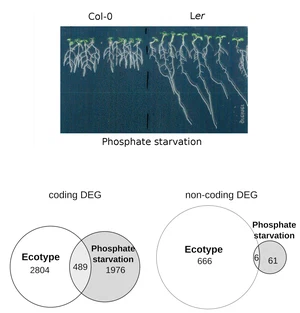
Natural variation between accessions provides a powerful system for studying lncRNA evolution and function. Root architecture varies widely between species and even between accessions of the same species, despite strong conservation of the coding portion of their genomes. By contrast, noncoding RNAs evolve rapidly between accessions and may contribute to differential environmental responses.
We compared the noncoding transcriptome of two Arabidopsis accessions, Columbia and Landsberg erecta, under phosphate starvation. Roots from these accessions respond differently to phosphate limitation, and stranded RNA-seq revealed that lncRNAs are far more variable between accessions than coding genes, even when their DNA sequence is conserved. We identified ecotype-specific lncRNAs linked to root responses, suggesting that changes in lncRNA expression may contribute to natural variation in root architecture and nutrient acquisition.
This work provides a framework for studying accession-level conservation of lncRNA expression and function. It also raises the question of how ecotype-specific lncRNAs arise and whether their functions can be conserved through changes in expression, structure or interactions with protein partners.
Evolutionary age and regulation of lincRNAs
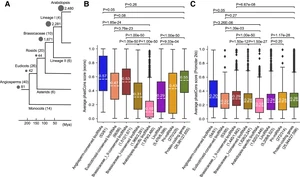
At the genome-wide level, we analysed the evolutionary age, sequence conservation and transcriptional regulation of Arabidopsis lincRNAs. By integrating eight annotation resources, we defined 6,599 high-confidence lincRNA loci and grouped them into evolutionary age classes. These classes differ substantially in sequence and chromatin features, in their level of conservation and in the purifying selection acting on them.
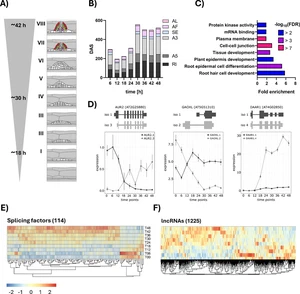
We then combined spatiotemporal gene expression profiles with transcription factor chromatin immunoprecipitation data to construct a TF–lincRNA regulatory network containing 2,659 lincRNAs and 15,686 interactions. Experimental validation confirmed that KANADI 1, MYB DOMAIN PROTEIN 44 and PHYTOCHROME INTERACTING FACTOR 4 are key regulators of root-specific lincRNA expression. We also identified 58 lincRNAs regulated by these transcription factors that show strong root cell-type-specific expression or chromatin accessibility and are linked to genetic associations related to root system development and growth.
These analyses connect lncRNA evolution to the evolution of regulatory networks. They suggest that the age of a lincRNA influences its sequence conservation, its chromatin environment and its integration into transcriptional networks, and they provide a framework for predicting the biological context and relevance of lincRNAs in Arabidopsis.
Conservation across species
Perspectives
Related publications