Root system architecture and developmental plasticity
Root architecture is highly plastic and determines how efficiently a plant explores the soil for water and nutrients. Lateral root initiation and emergence, gravitropic responses, root hair formation and root elongation are controlled by interacting transcriptional, hormonal and RNA-based mechanisms. We study how lncRNAs and their protein partners contribute to this plasticity.
ARES is a long intergenic noncoding RNA located downstream of the lateral root master regulator IAA14/SOLITARYROOT. Although ARES and IAA14 are co-regulated during development, genetic analyses showed that ARES does not control IAA14 expression. Instead, ARES modulates the expression of neighbouring genes, including the transcription factor NF-YB3, and affects a subset of ARF7-dependent genes. Knockdown and knockout of ARES alter root development, suggesting that ARES acts in trans to modulate auxin-dependent root architecture.
NF-YA10 provides another entry point into root developmental plasticity. NF-YA10 and NF-YA2 are downregulated by the specific miRNA isoform miR169defg. Plants expressing a miR169-resistant version of NF-YA10 show altered lateral root gravitropic responses and a modified area explored by the root system. Detailed phenotyping revealed that NF-YA10 directly regulates LAZY genes, which are linked to gravitropism, by binding to their promoter regions. This work places NF-YA10 in the transcriptional circuitry that controls root bending and soil exploration.
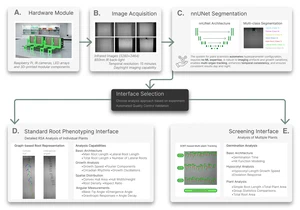
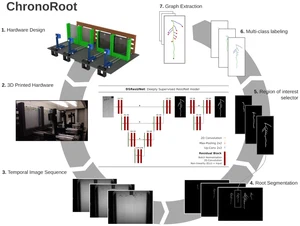
To capture these phenotypes quantitatively, we develop the ChronoRoot phenotyping platform. ChronoRoot combines 3D-printed open hardware with deep segmentation networks to follow root growth at high temporal resolution. ChronoRoot 2.0 extends the platform with multi-class segmentation, tracking of several plant organs and dedicated standard and screening interfaces. These tools allow us to measure subtle temporal parameters of root architecture and to connect molecular perturbations to quantitative developmental phenotypes.
Heat stress and environmental responses
Temperature stress triggers rapid transcriptional and post-transcriptional reprogramming. Plants must activate protective pathways while limiting growth penalties, and RNA-based regulation provides a flexible layer for coordinating these responses. We study how splicing factors and lncRNAs contribute to stress-responsive gene regulation.
The rice serine/arginine-rich splicing factor RS33 is involved in pre-mRNA splicing during abiotic stress responses. SR proteins are key regulators of splice-site selection, and alternative splicing of stress-responsive genes generates multiple isoforms that can contribute to protein diversity and regulatory feedback. Our work on RS33 connects splicing regulation to stress acclimation and provides a comparative view of RNA processing in monocots and dicots.
APOLO illustrates how an lncRNA can integrate temperature signals into root development. In response to cold, APOLO recognises the RHD6 locus and interacts with the transcription factor WRKY42. This interaction modulates WRKY42 binding to the RHD6 promoter, activates the RHD6-like gene RSL4 and promotes root hair cell expansion. The APOLO–WRKY42 complex therefore acts as a regulatory hub that links cold perception to root hair growth.
Our review of plant lncRNAs in environmental adaptation summarises the roles of lncRNAs in biotic and abiotic stress responses, including drought, heat, nutrient deficiency and pathogen interactions. It also discusses the emerging evidence for lncRNA involvement in stress memory, in which prior exposure to mild stress enhances the plant’s ability to respond to subsequent stress. These concepts provide a framework for understanding how lncRNAs contribute to acclimation and adaptation.
Gene regulatory networks integrating lncRNAs
LncRNAs are not isolated regulators but components of larger gene regulatory networks. Understanding their position in these networks is essential for predicting their function and for identifying the regulatory logic of plant development.
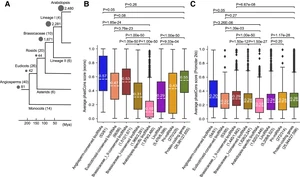
We reconstructed a transcription factor–lincRNA regulatory network in Arabidopsis by integrating eight annotation resources with spatiotemporal gene expression profiles and transcription factor chromatin immunoprecipitation data. The network contains 2,659 lincRNAs and 15,686 interactions. Using this network, we identified KANADI 1, MYB DOMAIN PROTEIN 44 and PHYTOCHROME INTERACTING FACTOR 4 as key regulators of root-specific lincRNA expression. Experimental validation confirmed their roles and identified lincRNAs with root cell-type-specific expression or chromatin accessibility, some of which are linked to genetic associations related to root system development and growth.
RNA processing and small-RNA pathways also connect lncRNAs to developmental networks. In Medicago truncatula, the SUPERKILLER complex subunit SKI3 guides mRNAs to the exosome for 3′-to-5′ degradation. Knockdown of SKI3 impairs miR172-directed cleavage of the mRNA encoding Nodule Number Control 1, an APETALA2 transcription factor that negatively modulates nodulation. This work identifies a regulatory hub that connects RNA degradation, small-RNA activity and root organogenesis.
Our review of regulatory lncRNAs in root growth and development integrates these findings with the broader literature. It discusses how lncRNAs respond to developmental and environmental signals, how they fine-tune gene expression, and how their functions can be placed within root developmental networks.
Perspectives
Related publications