Chromatin and epigenetic regulation
Several plant lncRNAs act as chromatin-associated regulators. They can recruit or sequester chromatin-modifying proteins, guide them to specific genomic regions, stabilise R-loops, or influence the three-dimensional organisation of chromatin. These activities allow lncRNAs to fine-tune the expression of neighbouring genes and to coordinate complex transcriptional programmes.
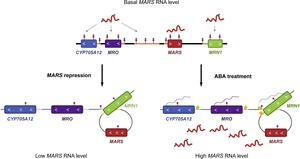
The lncRNA MARS is embedded within the Arabidopsis marneral biosynthetic gene cluster, a compact group of co-regulated genes involved in specialised metabolism. In response to abscisic acid, MARS controls the local epigenetic activation of the surrounding region, modulating the deposition of repressive histone marks and the binding of the Polycomb component LHP1. This work illustrates how a lncRNA can act as a local regulator of chromatin state and gene cluster coordination.
APOLO provides another example of chromatin-associated lncRNA function. APOLO is an R-loop-associated lncRNA that recognises multiple genomic loci and modulates their three-dimensional chromatin conformation. It interacts with the PRC1 component LHP1 and with the methylcytosine-binding protein VIM1, a conserved homolog of the mammalian UHRF1. Through these interactions, APOLO coordinates Polycomb action and DNA methylation at the YUCCA2 promoter during thermomorphogenesis. Strikingly, the human UPAT lncRNA, which shares neither sequence nor structure with APOLO, can also be recognised by VIM1 and LHP1 in plant cells. This suggests that functionally equivalent lncRNAs can emerge through conserved protein interactions even when their sequences diverge.
Our review of VIVIpary and the emergence of lncRNAs as chromatin regulators places these cases in a broader conceptual framework. It discusses how lncRNAs can influence chromatin architecture, transcriptional memory and the evolution of regulatory networks, and it highlights the questions that remain open in plant lncRNA biology.
lncRNA–protein interactions and alternative splicing
Other lncRNAs act through direct interactions with RNA-binding proteins, transcription factors or splicing factors. By acting as scaffolds, decoys or specificity factors, they can influence the availability, localisation or activity of proteins and thereby reshape transcriptional and post-transcriptional programmes.
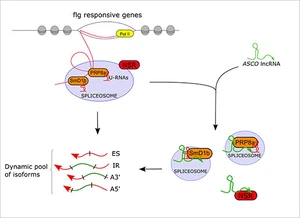
ASCO was one of the first plant lncRNAs shown to interact with the spliceosome-associated NSR proteins and to modulate alternative splicing. Our genome-wide analysis of ASCO knockdown and overexpression lines identified a large number of deregulated and differentially spliced genes related to flagellin responses and biotic stress. This work established ASCO as a regulator of the transcriptome through its interaction with splicing factors and provided a framework for studying how lncRNAs can influence splicing specificity.
APOLO also illustrates how lncRNA–protein interactions can connect environmental signals to developmental outputs. In response to cold, APOLO recognises the locus encoding the root hair master regulator RHD6 and interacts with the transcription factor WRKY42. This interaction modulates WRKY42 binding to the RHD6 promoter, activates RHD6-like RSL4 and promotes root hair cell expansion. The APOLO–WRKY42 complex therefore acts as a regulatory hub that integrates temperature signals into root hair growth.
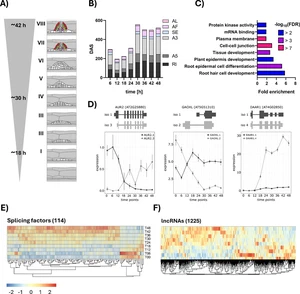
ACHLYS provides a more recent example of lncRNA-mediated splicing regulation. Using Arabidopsis lateral root development as a system, we identified lncRNAs that interact in vivo with the splicing factors NSRa and GRP7. ACHLYS affects more than 250 alternative splicing events and modulates the phase separation of NSRa, influencing its accumulation in nuclear speckles. Knockdown and overexpression of ACHLYS alter splicing patterns and root architecture, and the lncRNA is highly conserved in several Brassicaceae. This work suggests that lncRNAs can fine-tune splicing factor condensation and thereby control developmental transitions.
From individual mechanisms to predictive models
To move beyond individual examples, we compare the molecular and sequence features of characterised lncRNAs and ask which properties are associated with each mode of action. Relevant features include the presence of short conserved sequence or structural motifs, the ability to form R-loops, the identity of protein partners, the genomic position relative to target genes, and the position of the lncRNA within regulatory networks.
ARES is a useful case study for this comparative approach. ARES is located downstream of the lateral root master regulator IAA14/SLR and modulates the auxin response and root architecture in Arabidopsis. Although ARES and IAA14 are co-regulated during development, ARES knockdown and knockout do not affect IAA14 expression. Instead, ARES influences the expression of neighbouring genes, including the transcription factor NF-YB3, and a subset of ARF7-dependent genes. This suggests that ARES acts in trans to modulate auxin-dependent root development.
The carrot lncRNA study extends the analysis beyond Arabidopsis and shows that lncRNAs are also associated with the regulation of anthocyanin pigmentation in carrot storage roots. By combining stranded RNA-seq with the well-characterised anthocyanin biosynthesis pathway, this work identifies lncRNAs that may contribute to the regulation of pigment accumulation and provides a comparative system for studying lncRNA function in crops.
Our review of regulatory lncRNAs in root growth and development synthesises these and other examples. It discusses how lncRNAs respond to developmental and environmental cues, how they fine-tune gene expression, and how their functions can be integrated into models of root development. Building on these cases, we aim to define predictive signatures and to develop computational approaches that infer the likely mode of action of uncharacterised lncRNAs.
Related publications