Splicing regulation and spliceosome components
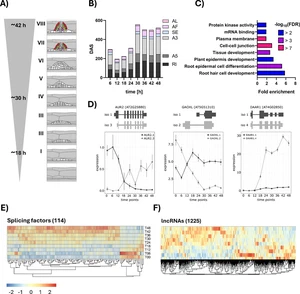
Alternative splicing is a major source of transcriptome and proteome diversity in plants. Splice-site selection depends on the spliceosome, on regulatory RNA sequences and on the activity of RNA-binding proteins such as serine/arginine- rich splicing factors. We study how spliceosome components and splicing factors contribute to splicing regulation and how their activity is connected to stress responses.
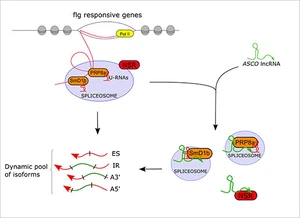
The spliceosome components PRP39a and SmD1b provide an example of how core splicing factors can influence post-transcriptional gene silencing. SmD1b was known to promote post-transcriptional silencing of sense transgenes, and we showed that PRP39a also plays a role in this process. However, PRP39a and SmD1b act differently in splicing and in silencing. RNA-seq analyses of prp39a and smd1b mutants identified distinct sets of deregulated transcripts and noncoding RNAs, and double mutant analyses revealed distinct genetic interactions with nuclear RNA quality control machineries. The two factors appear to synergistically promote a step specific to sense transgene silencing, limiting the degradation of aberrant RNAs and favouring their export to the cytoplasm.
The SF3B complex, a multiprotein component of the U2 snRNP, plays a crucial role in recognising the branch point sequence and in spliceosome assembly. Using CRISPR-mediated directed evolution, we generated splicing inhibitor-resistant mutants of SF3B1 and PHF5A in rice. These mutants revealed overlapping roles of the two subunits in splicing regulation and provided tools to dissect the function of the SF3B complex in plants.
The rice serine/arginine-rich splicing factor RS33 is involved in pre-mRNA splicing during abiotic stress responses. SR proteins influence splice-site selection, and alternative splicing of stress-responsive genes generates multiple isoforms that can contribute to protein diversity and regulatory feedback. Our work on RS33 connects splicing regulation to stress acclimation and provides a comparative view of RNA processing in monocots and dicots.
LncRNAs can also influence splicing by interacting with splicing factors. ASCO interacts with the NSR proteins and modulates alternative splicing genome-wide, affecting genes related to flagellin responses and biotic stress. ACHLYS interacts with NSRa and GRP7, affects more than 250 alternative splicing events and modulates NSRa phase separation and accumulation in nuclear speckles. These examples show how lncRNAs can act as specificity factors or scaffolds within ribonucleoprotein complexes.
Small RNAs, RNA quality control and silencing
RNA quality control and small-RNA pathways shape transcript fate. In plants, aberrant RNAs produced by endogenous genes or transgenes are normally degraded by nuclear and cytosolic RNA quality control pathways. Under certain biotic or abiotic stresses, quality control is impaired, and aberrant RNAs are converted into small interfering RNAs that initiate post-transcriptional gene silencing in the cytosol. How aberrant RNAs are selected and brought to the cytoplasm is a central question in RNA biology.
We showed that the RNA-binding protein SGS3 shuttles between the cytosol and the nucleus, where it associates with the ISWI-like chromatin remodeler CHR11 and with RNAs transcribed from silencing-sensitive loci. Knocking down CHR11 and its paralog CHR17 strongly reduces transgene post-transcriptional silencing, suggesting that SGS3 recruitment by CHR11/17 facilitates the initiation of silencing. CHR11 is also enriched at endogenous protein-coding genes that produce natural antisense siRNAs and va-siRNAs under biotic or abiotic stress, and this production is reduced in chr11 chr17 double mutants. Impairing CHR11 and CHR17 rescues the lethal phenotype caused by massive siRNA production in RNA quality control-deficient mutants. These results suggest that SGS3 recruitment by CHR11/17 allows RNAs to be exported to the cytosol to initiate siRNA production.
Spliceosome components can also influence post-transcriptional silencing and DNA methylation. Our work on PRP39a and SmD1b, together with the commentary on splicing and transgene DNA methylation, connects splicing regulation to epigenetic silencing and highlights how RNA processing can influence the inheritance and expression of transgenes.
RNA degradation and small-RNA pathways also control plant development. In Medicago truncatula, the SUPERKILLER complex subunit SKI3 guides mRNAs to the exosome for 3′-to-5′ degradation. Knockdown of SKI3 impairs miR172-directed cleavage of the mRNA encoding Nodule Number Control 1, an APETALA2 transcription factor that negatively modulates nodulation. This work identifies a regulatory hub that connects RNA degradation, small-RNA activity and root organogenesis.
RNA modification and post-transcriptional control
Post-transcriptional regulation extends to chemical modification of RNA. N6-methyladenosine (m6A) is a widespread modification of plant mRNAs that can influence transcript stability, splicing, translation and decay. Despite its importance, the dynamics and regulatory potential of m6A during biotic stress in plants remain poorly understood.
We provided a comprehensive view of the effects of m6A on short-term and long-term responses to pathogen signalling in Arabidopsis. m6A-deficient plants are more resistant to bacterial and fungal pathogen infections and show altered immune responses. m6A deposition is specifically coordinated on transcripts involved in defence and immunity before and after the perception of the pathogen signal flagellin. The dynamic modulation of m6A on specific stress-responsive transcripts is correlated with changes in transcript abundance and cleavage. These results show that the m6A methylome is regulated before and during pathogen stress and that it functions in coordinating growth and pathogen responses.
Perspectives
Related publications